Carbon accounting where every figure is traceable

Emissa helps UK businesses measure, report and reduce their greenhouse gas emissions. Upload the bills and invoices you already have and get an auditable emissions ledger, UK SRS-aligned disclosures, and reports your assurance provider can verify line by line.

Book a demo See the platform
The Emissa emissions dashboard: totals by scope, hotspots by category, reporting periods compared
Measure · Report · Reduce

One ledger, three jobs

The product is organised the way the work is: capture activity data, turn it into disclosure-ready reporting, and manage the reductions that follow.
Measure — data in, without the spreadsheet grind

  • Upload the paperwork you already have. Bills, receipts, statements and portal exports — Emissa AI reads each document and proposes a scoped ledger entry with its reasoning and confidence. Nothing enters the ledger until a person confirms it.
  • Every route lands in one audited ledger. CSV import, estimation models, supplier spend documents or manual entry — same validation, same audit trail.
  • Official Defra conversion factors, versioned. Each annual gov.uk release is imported automatically and applies to activity dated in its own year — publishing a new release never changes an existing figure.
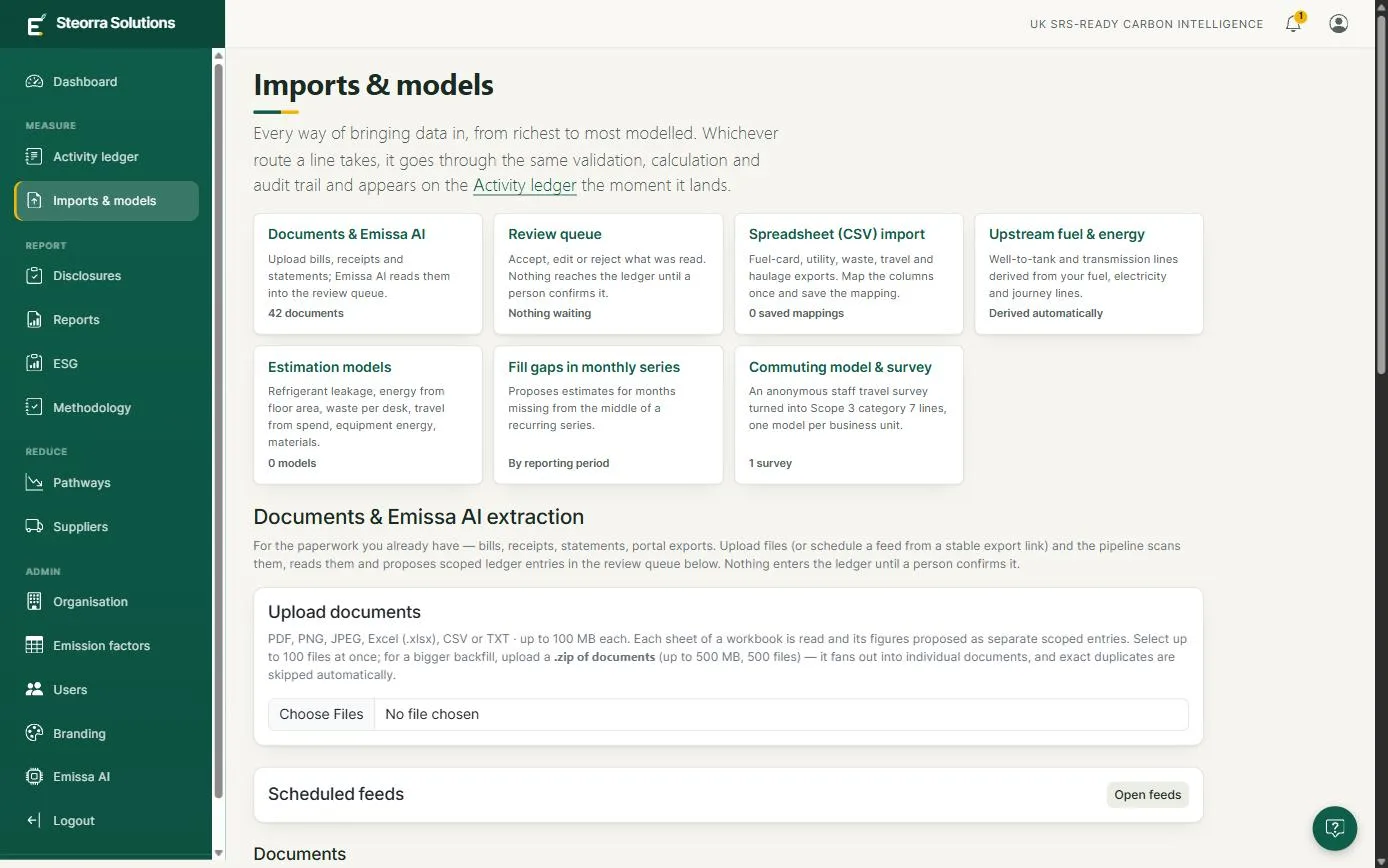
The Imports and models page: document upload with Emissa AI extraction, a human review queue, CSV import and the estimation tools

Report — UK SRS-shaped from day one

  • A disclosure workbook, not a blank page. Every requirement is a task with an owner, status, evidence and narrative — structured on the IFRS S1/S2 four pillars behind UK SRS, with relief elections recorded, not hidden. When the final FCA/DBT rules land, the mapping updates by configuration, not by release.
  • Branded PDF and DOCX reports with the methodology, engine version and factor-set checksums stated — plus Scope 2 shown both location- and market-based.
  • An audit pack your assurance provider will actually want: every figure, every calculation trace and every factor version in one zip.
Disclosure workbook: UK SRS requirements as tasks with owners, status and relief elections

Reduce — targets tracked against reality

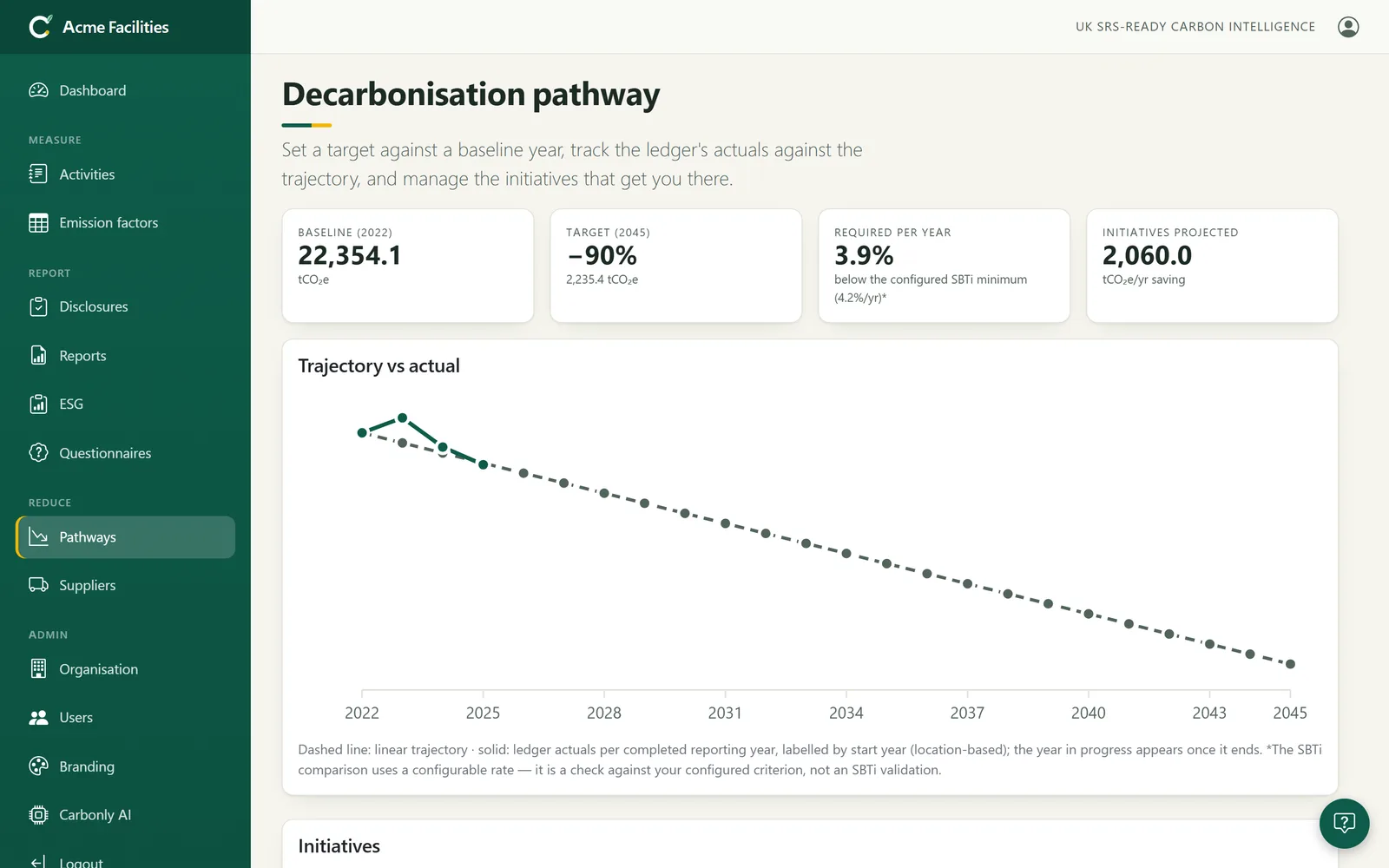
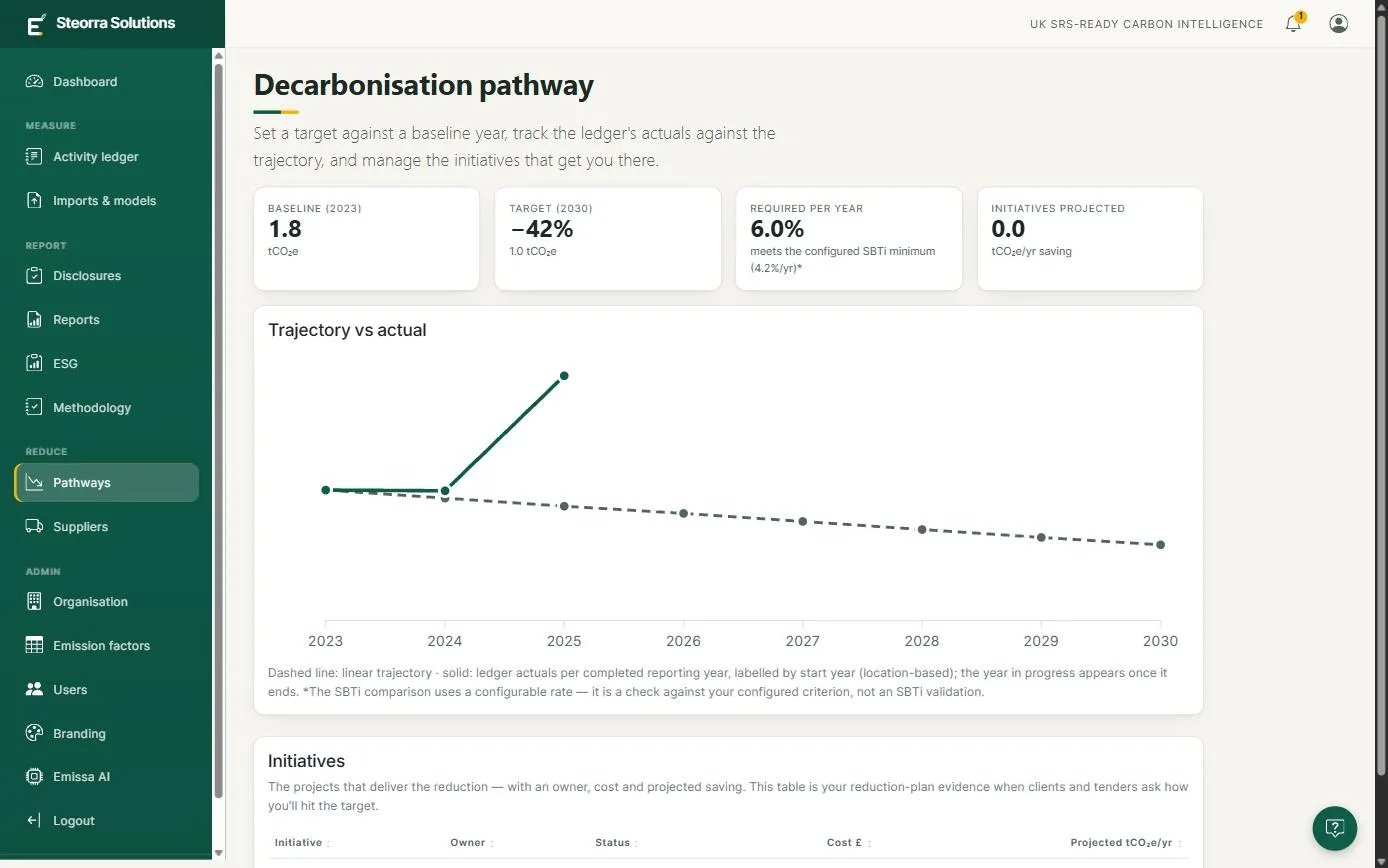
  • Decarbonisation pathways snapshot a baseline from your own ledger and chart actuals against the trajectory — with the required annual reduction checked against a configurable criterion such as the SBTi minimum rate.
  • Initiatives with owners, costs and projected savings, so the plan behind the line is visible.
  • A supplier portal that invites your suppliers to submit real product emissions — reviewed submissions become supplier-specific Scope 3 factors with full provenance.
Decarbonisation pathway: baseline, target trajectory and ledger actuals
Methodology

A methodology statement the product keeps honest

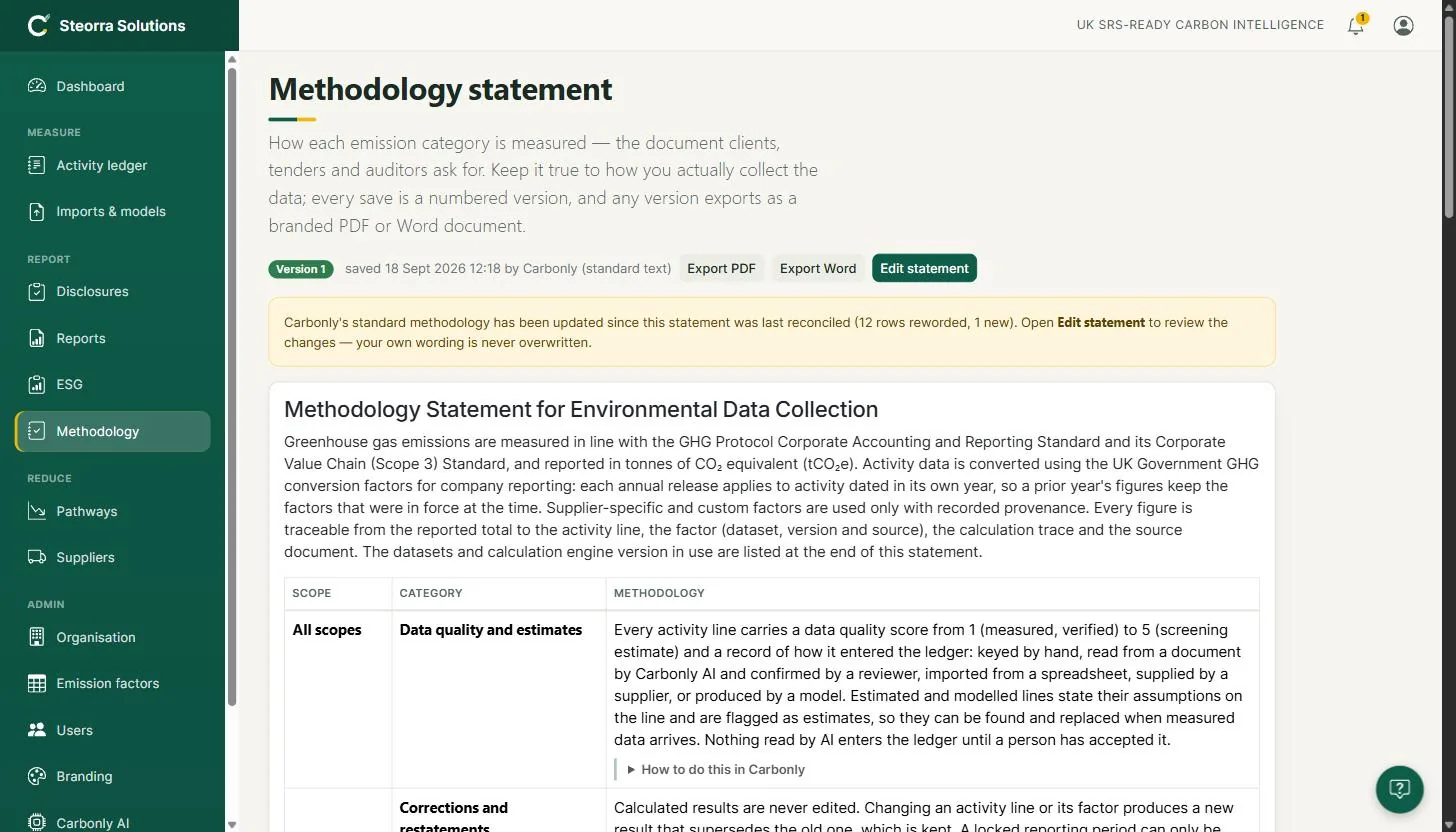
Clients, tenders and assurance providers ask how each category is measured. Emissa ships the statement as a living document: written in the product, versioned on every save, exported as a branded PDF or Word file, and printed inside the disclosure report.
Versioned, exportable, never overwritten

  • Numbered versions with a change note. Every save is a new version; any version can be restored or exported, and the report always prints the current one.
  • Standard wording, offered row by row. When the calculation logic changes, Emissa's standard text is updated with it — and offered to each client as a suggestion. Your own wording is never replaced without a person accepting the change.
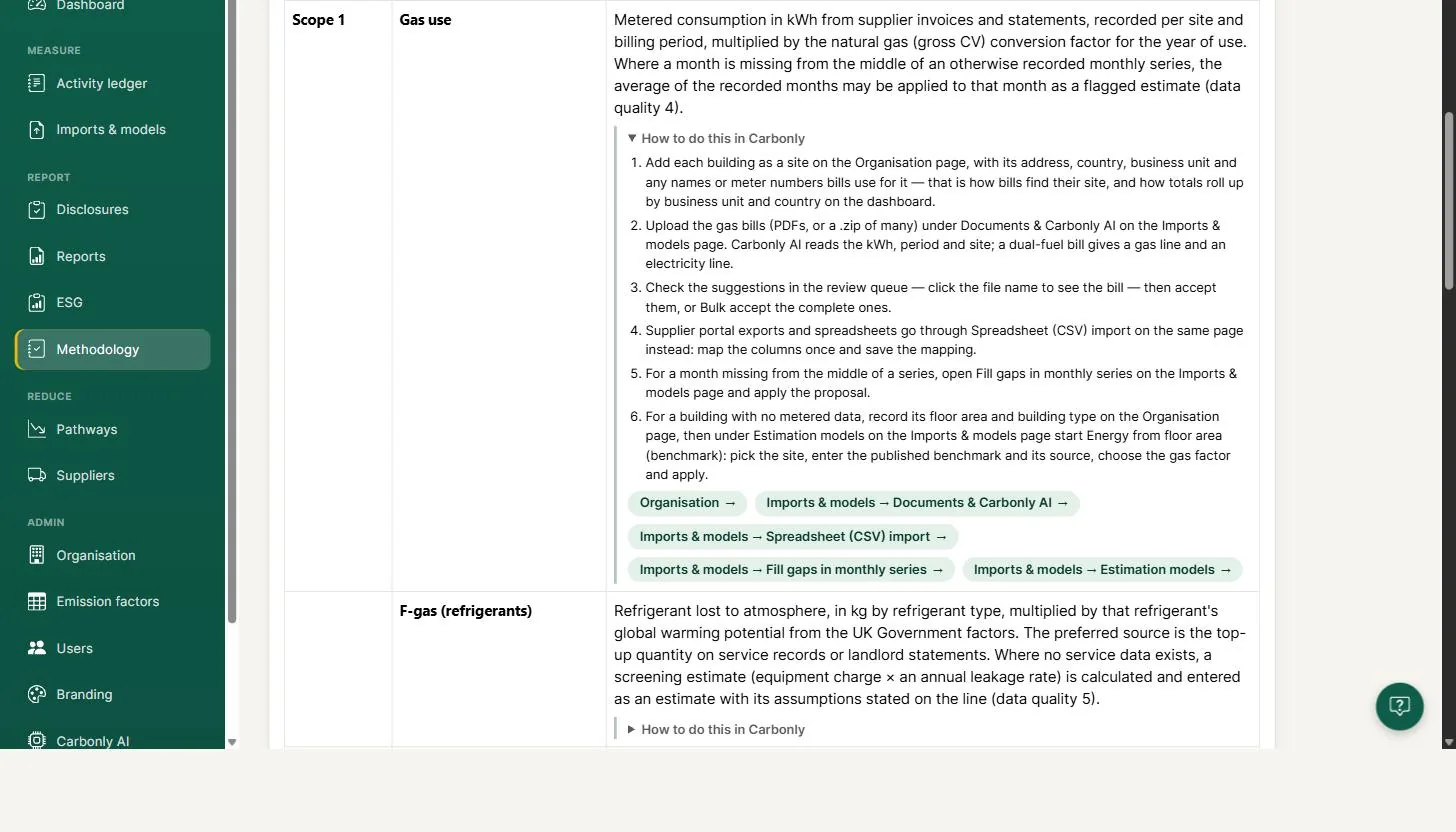
  • "How to do this in Emissa" under every row. Each method comes with the steps and links that carry it out in the product, so the statement is also the working instructions for the team collecting the data.
The Methodology statement page: version badge, PDF and Word export, and the standard-text update notice above the statement table

Every method is executable

  • Steps in the product's own words. Which page, which button, which column to map — with a link that opens the right section.
  • Kept current by release. The instructions ship with the product, so every client sees the latest steps the moment a release lands, without editing their statement.
  • Guidance stays out of the export. The client-facing PDF and Word documents carry the method, not the instructions.
A methodology row for gas use expanded to show the numbered How-to steps and links into the product
Imports & models

The spreadsheets behind the estimates, retired

Where measured data does not exist yet, most teams keep a spreadsheet of assumptions. Emissa keeps those calculations in the product instead — with the assumptions, their source and the arithmetic written onto every line they produce.
One page for every way data comes in

  • Documents read by Emissa AI into a human review queue; spreadsheet imports with saved column mappings; and the estimation tools — each a tile with a live count, each a section you can link to.
  • Every route lands in the same ledger, through the same validation, calculation and audit trail.
  • Estimates are flagged as estimates, with their data quality score, so auditors can find them and you can replace them when real data arrives.
The Imports and models page: tiles for documents, review queue, CSV import, upstream energy, estimation models, gap fill and the commuting survey

Estimation models with the working shown

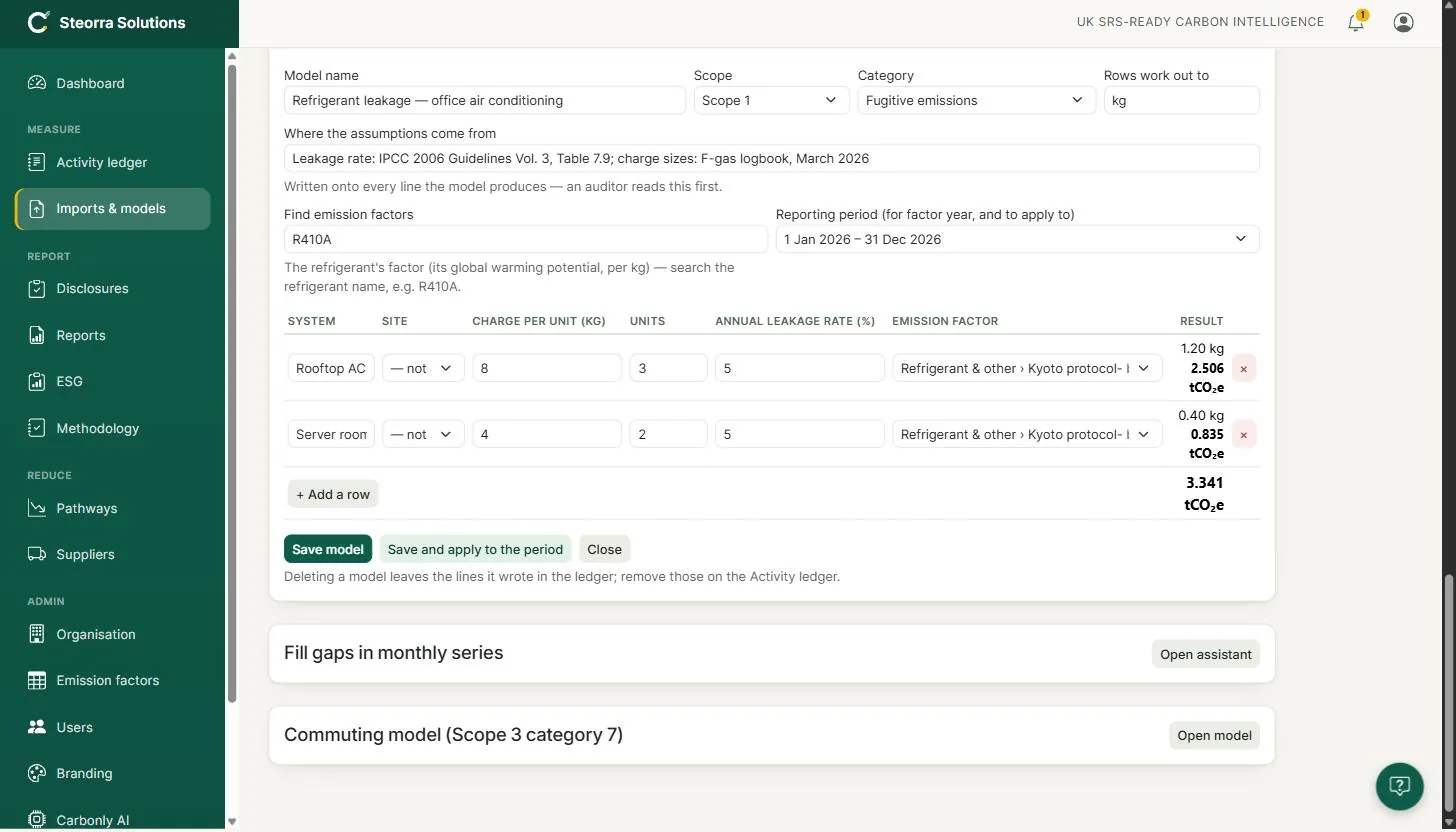
  • Six templates, no built-in numbers. Refrigerant leakage, energy from floor area, waste from desk numbers, travel from spend, equipment energy and materials by weight — you enter the assumptions and where they come from. The source is mandatory.
  • Rows of inputs, one factor per row, previewed as tCO₂e before anything is saved. Applying a model writes ordinary ledger lines with the working on each; re-applying replaces its earlier lines rather than adding to them.
  • Scope and category are yours to set: the same equipment model can report machines you operate under Scope 2 and products you sell under Scope 3.
An estimation model for refrigerant leakage: two rows of charge, units and leakage rate, the chosen R410A factor, and the tCO₂e result per row
How a model row becomes a line charge × units × leakage rate × factor
Upstream lines, derived not uplifted one fuel line, its well-to-tank and transmission losses follow
Flights from airport codes great-circle distance, then the haul band picks the factor family
Commuting from a survey, not a guess four anonymous answers per person, one model per business unit

Travel and commuting without the spreadsheet

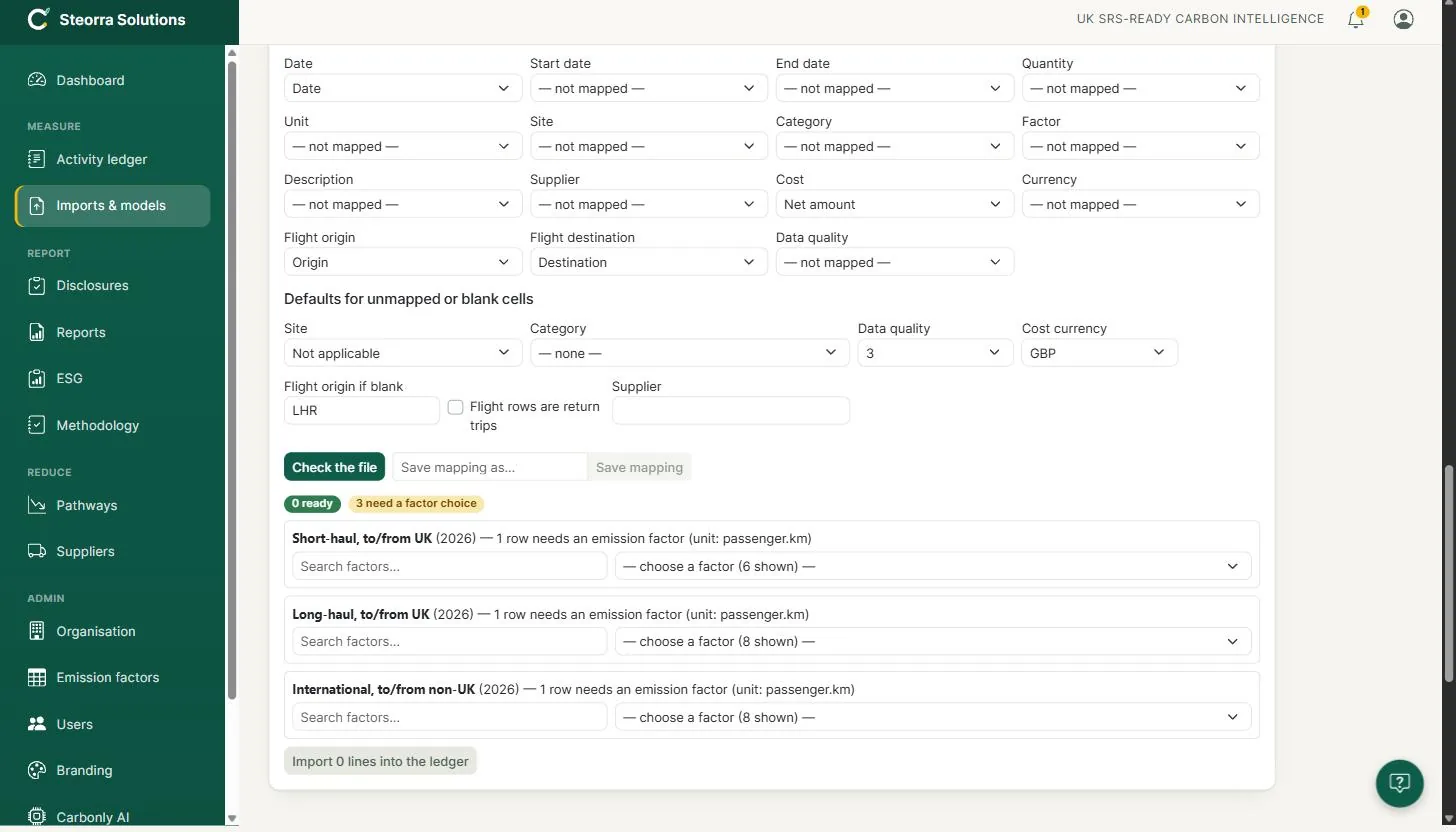
  • Flights from origin and destination. Map two airport columns and the importer works out the distance, the passengers and the haul band, and asks for the factor once per band. A missing origin can take a stated default — the assumption is written on the line.
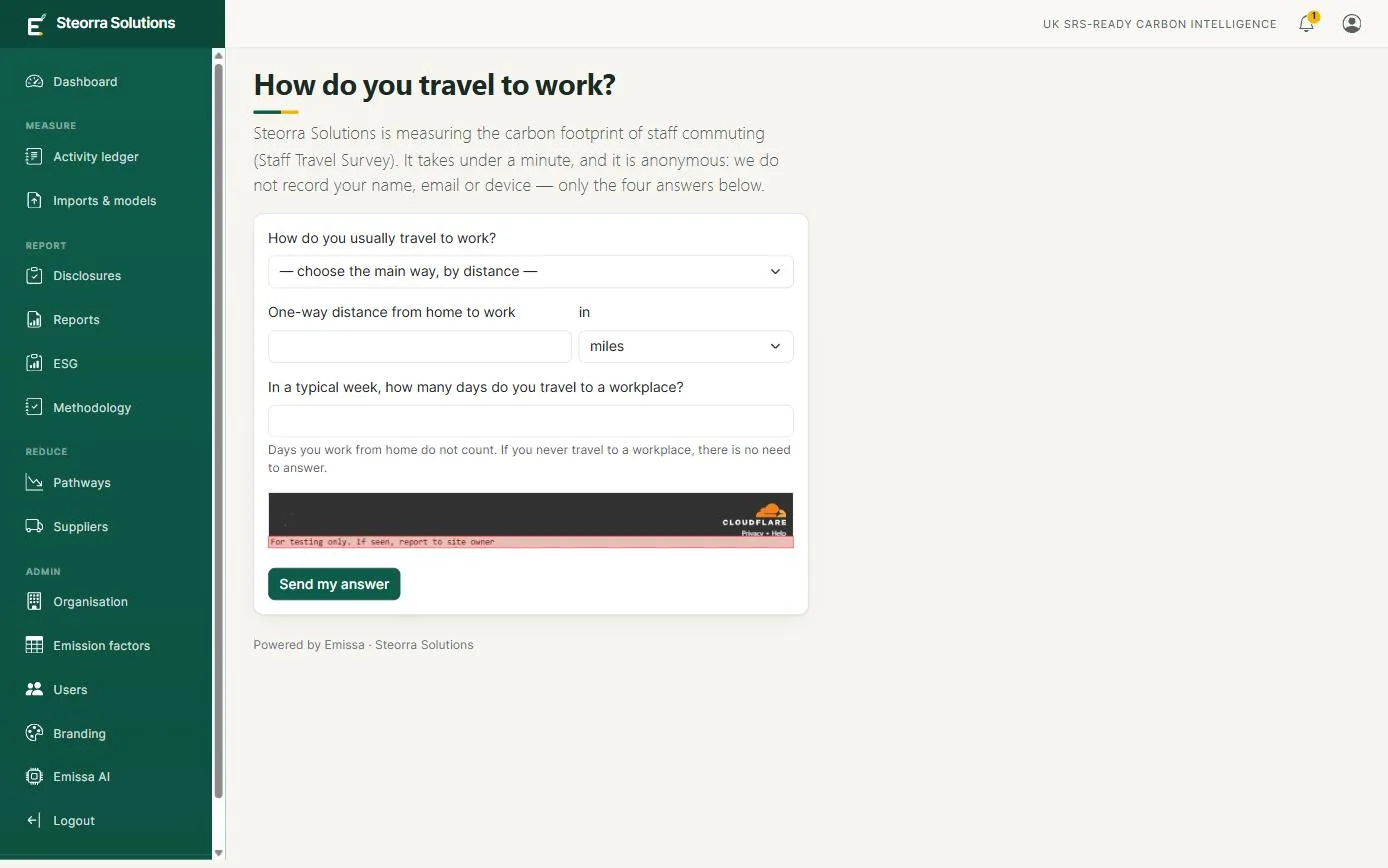
  • A staff travel survey collected in the platform. One shareable link per business unit, four questions, nothing identifying stored. "Fill the model from these answers" turns the responses into the mode split and distances.
  • Well-to-tank for journeys, exactly. Travel, commuting and freight lines derive their upstream line from the same distance, in the same category.
The CSV importer with Flight origin and Flight destination columns mapped, a default origin of LHR, and three rows grouped into short-haul, long-haul and international factor choices

Structure that rolls up

  • Business units and countries. Sites carry a business unit, country, floor area, building type, desks and staff numbers; the dashboard rolls totals up by unit and by country.
  • The right grid factor for each country. Add a country's published electricity factor with its source once, and bills for sites in that country take it automatically — the dashboard flags any line still on another country's factor.
  • Spend routed before it is estimated. Procurement spend is split into operating, capital and excluded — capital goes to category 2, fuel and energy are left out of the spend-based estimate — so nothing is subtracted by hand and nothing is counted twice.
The public commuting survey page: main mode of travel, one-way distance, days a week at a workplace, and a bot check before sending
Traceability

Auditable by construction

Every number in an Emissa report can be walked backwards to what produced it. The calculation engine is deterministic and version-stamped; results are append-only, so recalculation supersedes — it never overwrites history.

Source document→Activity record→ Factor (set + version + checksum)→Replayable trace→ Result→Report

Hash-chained audit trail

Every insert, update and delete writes a tamper-evident audit event — who, what, before and after, chained by hash.

Factors are data, never code

Conversion factors only exist inside versioned datasets published by the control plane. Nothing is hard-coded, nothing is invented.

Locked periods stay locked

Reported periods reject silent changes — corrections go through restatements with a recorded explanation.
Emissa AI

Intelligence that stays inside your stack

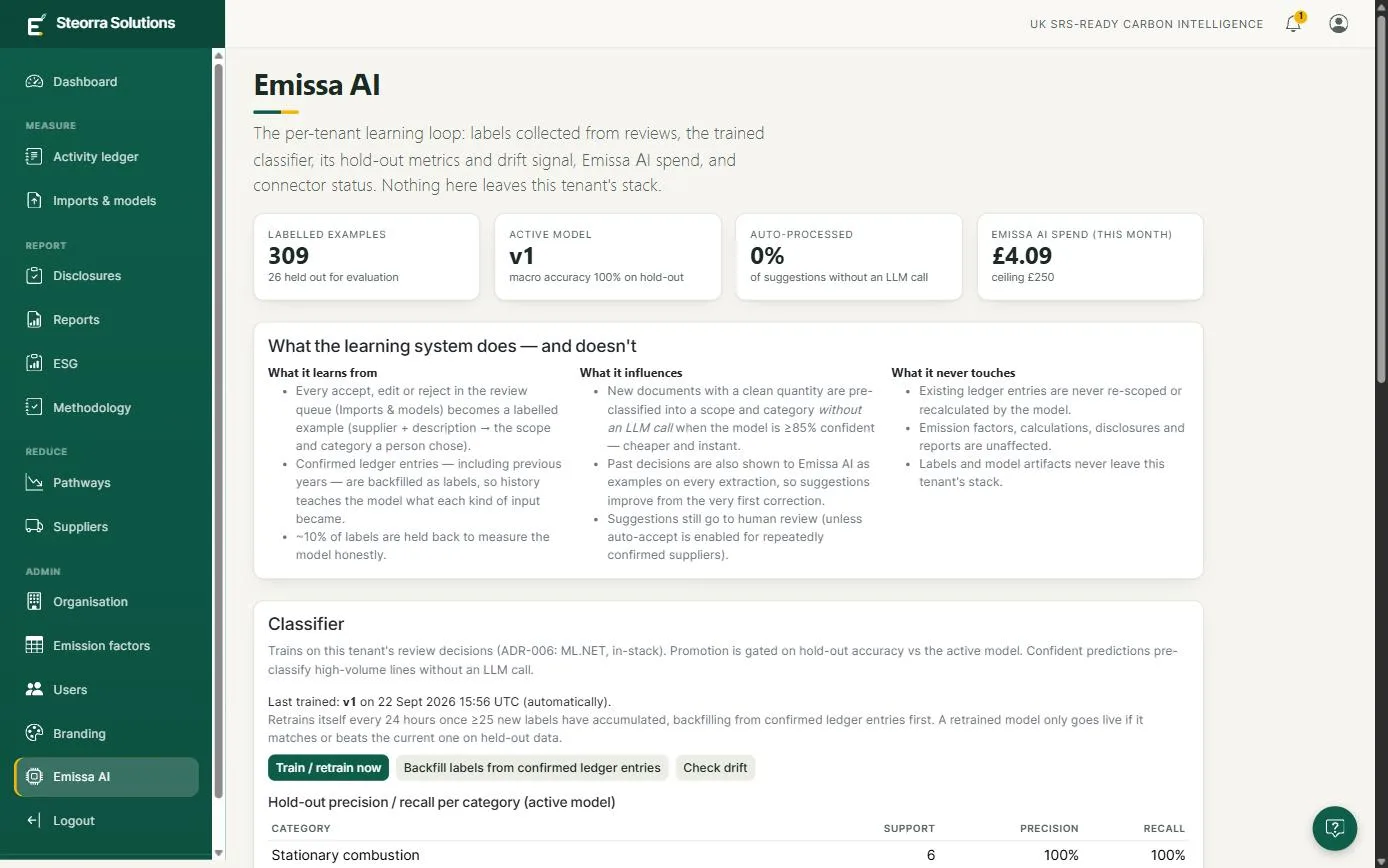
  • Human in the loop, always. Emissa AI suggestions carry confidence and reasoning; people accept, edit or reject — and every decision teaches the system.
  • A classifier trained only on your data, promoted only when it beats the current model on held-out examples. Confident, repeat suppliers get classified with no model call at all — faster and cheaper.
  • Honest metrics on show: accuracy, drift and monthly Emissa AI spend against a per-client cost ceiling, all on one dashboard. Your labels and models never leave your own environment.
Emissa AI dashboard: labelled examples, model accuracy, spend against ceiling
Architecture

One isolated stack per client

Emissa is not a shared database with a customer column. Each client runs their own deployment — isolation is physical, then enforced again in code.

Your own database

A dedicated PostgreSQL database per client — plus tenant-scoped query filters and an interceptor that treats any cross-tenant write as a security incident, not a bug.

Your own storage & queues

A dedicated object-storage bucket for evidence, reports and AI model artefacts, and dedicated message queues for the processing pipeline.

Your own applications

Web app, API and workers run as your own containers, with your branding, locale, reporting year and feature configuration — updated without redeployment.

Scalability

Provisioned in one step, portable by design

One command per client

A new client's entire stack — database, migrations, storage, queues, configuration and admin invitation — is provisioned by a single idempotent, resumable operation.

Runs where you need it

The same stack shape runs on a single server or on Kubernetes, so the platform grows with its clients rather than being rebuilt for them.

Factors keep themselves current

Annual Defra releases are detected, imported and published to every client automatically — each year's activity calculated against its own year's factors.

Security & trust

Built like it will be audited — because it will be

Strong sign-in by default

Invitation-only registration, mandatory multi-factor authentication, passkey support, bot protection and breached-password checks on every account.

Least privilege, visible

Role-based access down to individual pages — including a read-only Auditor role — with per-client SSO available by configuration.

A verifiable supply chain

Signed container images with a software bill of materials, dependency and vulnerability scanning in CI, and encryption in transit and at rest via the hosting platform. DPIA, disaster-recovery and penetration-test readiness packs included.

Frameworks

Enter data once, answer everyone

The ledger follows the GHG Protocol — all three scopes, all fifteen Scope 3 categories, Scope 2 dual reporting. Disclosure requirements cross-reference adjacent frameworks so the same data answers more than one question.

GHG ProtocolUK SRS S1/S2 (draft-aligned)SECR TCFDCSRD / ESRSCDPSBTi-style checks

The UK SRS workbook is structured on the public IFRS S1/S2 four-pillar framework while the final FCA/DBT rules are pending — Emissa says so in the product, and the official mapping replaces the template by configuration the day it is published. Pathway checks against the SBTi rate are a configurable criterion, not an SBTi validation.

See it with your own data

A demo takes half an hour — bring a handful of real bills and watch them become an auditable ledger.

Book a demo